
Everything Wrong with ‘Restore Britain’
The following is transcript of a video released on my Youtube channel: https://www.youtube.com/watch?v=aQeV1q7qNhQ&t=3785s

Introduction
The subject of this video is pretty self-explanatory. It’s to unpack everything that is wrong with Restore Britain, in my view, and to explain why I cannot suppprt or be a part of it.
It’s a great shame because, like many people similar to me who lean left on economics but right on culture, I have been searching for a patriotic, less austerity-orientated conservative movement to get behind and be involved in for years. One of the last things I wanted to see emerge was another form of Thatcherism, let alone one washed down with anachronistic aesthetics showcasing a version of Britain that looks more like something you’d find in Studio Ghibli or Columbia from Bioshock Infinite than Britain as it has ever actually existed. That, unfortunately, is what we have with Restore Britain.
My disappointment isn’t just related to the poor optics or the theoretical flaws of the political project itself (which I will explain in this video). It extends to how distastefully some of Rupert Lowe’s chosen people have behaved since the party was launched, despite being placed in positions of authority above people far more experienced and qualified than themselves. I’m seriously worried by their motivations, the sorts of characters they seem to be drawing to the party and, most importantly perhaps, whether Rupert is even in charge at this point.
I haven’t made these judgements just from watching and listening to the campaign since the launch of the party. I’ve been paying attention to the noises coming out of the associated events, meetings and conferences for a while, and there are honestly so many things wrong that it is not only destined to be politically counterproductive to the end of restoring anything in Britain, but is also at risk of making a lot of those involved look quite silly and potentially ruin the careers of the councillors and MPs who decide to defect, whether now or in the future.
I’ve narrowed down the weaknesses to four key areas: the first concerns the philosophy. The second concerns the policies. The third concerns the people and the fourth concerns the strategy.
Weakness 1: The Philosophy
This is the most consequential weakness in the long run: if we’re to judge Restore Britain by the obvious disjunction between the policies you’ll find on the official website and how it has marketed itself since it was officially launched as a political party, there is a complete absence of a cohesive political philosophy. I can imagine some arguing in response that the phrase “Restore Britain” is self-explanatory, but it isn’t, and the social media optics (which we’ll go into a bit more later) demonstrate just how thin, shallow and confused the party’s concept of restoration is. Some of you may be wondering whether having a cohesive philosophy matters. However, in the case of Restore Britain, it really does matter because it is proposing something quite radical if not “revolutionary” (that word has been used by Restore’s official spokespeople, by the way); if there’s no big idea behind how Britain is going to be restored, then what does “Restore Britain” mean?
Now, it is true that neither of the two largest political parties, namely Labour and the Conservatives, operates under a single underlying philosophy. They’re better understood these days as big-tent political organisations composed of different people and lobby groups competing internally to achieve a similar end. But that only works for them because they’ve been established for a long time, relatively speaking. The success of Reform, like UKIP a decade or so ago, has been built on providing a political home for those who have been pushed out of the modern Conservative Party’s big tent due to having concerns about immigration and the cancer operating under the name of “Diversity, Equity and Inclusion” that were too strong for the mainstream big-C conservatives. In terms of policy, Restore Britain is remarkably similar if not identical to Reform (in some areas), so in order to make any impression on the current political climate, it has to be more than a Rupert Lowe fan club and actually offer something that Reform isn’t offering already.
Restore could have done this if it backed up its policies with a solid and cohesive political and moral philosophy. It could have put itself in the position of saying: ‘yeah okay, we’re not that dissimilar from Reform policy-wise, given that Reform is where we sprung from. However, what distinguishes us from the modern-day Tory Party 2.0 (that Reform now is), is that everything that we’re offering is a reflection of who we are, the sort of government we aspire to be and the sort of country we want to pass on to future generations. In other words, we are people of serious conviction. Our policies are not just crowd pleasers that we include just to score points of some kind, but things that we believe in and will thus implement effectively.”
Maybe I was just hopelessly optimistic, but I thought that having a more robust code of conduct on how people and politicians should treat each other was built into the Restore fabric, given that the project itself started with Rupert being stabbed in the back by the Reform leadership. I thought this could give rise to a more sincere, grassroots conservative movement. Regrettably, however, Restore has only managed to do a single thing right since its party launch, and that is to identify that it has to evolve into something more than a Rupert Lowe fan club. The marketing and messaging on the early campaign trail, however, has been disorganised, poorly thought out, and in some cases, quite embarrassing, as unfortunately demonstrated by Charlie through his appearance on Alex Phillips’ Talk TV show. This, I’m afraid, is inexcusable and entirely the result of a lack of preparation and political consultation, which matters when you want to get elected.
You would think that having decided to adopt some form of ethnonationalism as an alternative to Reform’s civic postracialism, and had months to discuss the details of what ethnicity and being British amounts to among themselves, they’d have established a firm definition of what it means to be ethnically British in contrast with what it means to be ethnically English, but clearly that went amiss somehow.
Weakness 2: The Policies
The policies are not all bad. In fact, many of them are good.
Deporting illegal immigrants (in principle, good. And they’ve gone to much greater lengths than Reform to explain how they would do it, which is also good)
Reversing the “Boriswave” — pretty much the same as the first: in principle, good, for as long as the people they’re deporting are indeed unemployed or scrounging and not providing an essential service that we can’t be without.
Doing what’s required to have a functioning border — in other words, leaving the ECHR. I’d rather not leave the ECHR, but if there is no way of amending the legislation to actually uphold a country’s right to sustain its parent culture, then leaving is our only option.
Restoring town centres across the UK and, in particular, investigating the cause of the barber shop/ nail salon and vape shop epidemic (in principle, good, as almost all of our town centres have turned into tacky shitholes composed of ‘businesses’ that are almost certainly fronts for washing drug money or worse).
Using the state to engender more hospitable conditions for people to have families and get married (this is excellent because this social structure is fundamental to the renewal of the high-trust civil society).
Defunding the BBC. This is regrettable (because I still like much of what the BBC produces, but its unwavering commitments towards Diversity, Equity and Inclusion make it necessary at this point).
Having our courts recognise the right to self-defence (we should be protecting the victims of crime, not persecuting them for defending themselves).
Abolishing inheritance tax — inheritance is already taxed as income is accumulated; it shouldn’t be taxed twice. At this point, it amounts to nothing more than class warfare against the middle class. Inheritance tax doesn’t affect the upper class as much as people think due to significantly higher access they have to wealth management.
Repealing the draconian censorship legislation that allows the CPS to imprison people for “tweeting” when violence isn’t incited.
Having an independent inquiry into the COVID-19 vaccines (this would be an excellent opportunity to decipher whether the more adventurous claims being made are the result of conspiracy theories or not)
Reforming the postal voting system to thwart coercive bloc-voting (this is absolutely essential because it is a serious problem right now that’s only going to get worse if we don’t intervene)
Using tents rather than hotels for asylum seekers (that would most likely be an effective deterrent)
Infrastructure First Housing Policy (this is also very important. In many of these new developments (I’ve seen them for myself), there are too many awful-looking houses and blocks of flats and not enough shops, community centres, schools or doctors’ surgeries. You can’t have a community or the most basic of social lives without said infrastructure.
(Okay, that’s it for the Good, but before getting onto the Bad, there are several policies that l have put in the Undecided category)
Restore’s policy on the NHS seems sensible and is certainly more promising than Reform’s, but is extremely lacking in detail (so I’m suspending judgement on that).
Abolishing net zero. (I simply don’t have the scientific knowledge to have an informed opinion about whether subjecting consumers to higher energy prices to reduce carbon emissions is ethically justified or not, and neither do most of the people talking about it, to be brutally honest, so I’m going to abstain from weighing in on something I know nothing about).
Repealing the Online Safety Act. I’ll be honest with you, I like what the current government is trying to do (in principle, I should stress) to protect children from harmful or explicit content online because, let’s face it, a lot of parents these days are useless at monitoring what their children are doing, and there are social consequences to that.
^ In an ideal world, yes, it should be the remit of the parents to control what content their children can watch, but that’s not the world we live in at the moment. The family institution has taken a lot of damage over the last few decades, so unfortunately, more is required from the state to protect children and nullify the social consequences of bad parenting. That said, I’m also acutely aware that there are many potential alternative motives behind this legislation, which is by no means limited to policing what adults can watch under the umbrella of “harmful misinformation”.
The Bad
While I’m generally on board with the idea of remigration, because the changes that this country has succumbed to in this millennium amounts to a social and moral crime that our politicians had no right or mandate to subject us to, the inclusion of the term “human rights” in quotation marks on the policy page could be interpreted to imply that the party has the intention of pulling away from the persisting post-war consensus (based on the international recognition of natural law).
Indeed, the quotation marks could be referring to the extent to which the term “human rights” has assumed a nominal status. If so, then I readily agree. However, the party’s brief statement on foreign policy (found under the heading “Put British Interests First”) reads as excessively isolationist. There is, of course, nothing wrong with prioritising your nation’s interests over others (in fact, I would argue that’s a functional prerogative of being a nation-state). But pulling away from every single international convention solely on the formal basis that they come from outside is reckless and counterproductive, and will increase the likelihood of conflicts in the future.
^ Having international law and order is a good thing and a practical condition for national security; this is something that every intelligent person recognises. The matter of contention is what the terms of international cooperation should be; it doesn’t have to be the so-called “globalist” one that Blair and the European Union of old were aggressively pursuing. In the world as it currently exists, we cannot be without political and economic alliances. Rather than cast ourselves away, we need to remain outward-looking and look to forge new alliances and terms of engagement as an independent nation with other independent nations.
Equally concerning to me, however, are the assertions displayed in their plans to “Rebuild Britain’s Industry, Infrastructure, and Energy Security”. Restore appears to have chosen to run with the low-resolution reading of the housing crisis, hence its proliferation of the view that young people are being priced out of home ownership because of immigration and red tape. I’m not denying that red tape and immigration add to the problem, in some cases exponentially. But it’s economically illiterate and frankly dishonest to overlook the factor of “rentierism” or “landlordism”. Houses are expensive because they’ve evolved in great part to be buy-and-hold investments as well as homes, with the growing demand for housing (caused by immigration) serving the mechanical function of perpetually strengthening the hand of the property-owning class. If you want to know why so many big C-conservatives are big on deregulation and low taxes but weirdly liberal on immigration, this is one of the more compelling reasons why.
^ Cutting down on immigration, regulation and administering mass deportations will not solve the problem of inflating house prices. Affordable housing can only be achieved with the input of protectionism (stopping foreign investors from buying properties and gaining stakes in housing development projects) and preventing property from being a portfolio asset for people who already have homes in the first place.
Moving on to their energy policy. I agree that Britain should live off and own its own energy supply, but if we’re insisting on doing that by extracting shale gas, then you have to accept that that comes with considerable risks to the environment. Returning to fossil fuels may be necessary for now (given that net zero isn’t sustainable for other reasons), but we simply cannot have long-term energy security without either an infinite supply of fossil fuels (which we don’t have) or some form of hybrid system that includes renewables to at least minimise our reliance on unsustainable sources. Investing in nuclear energy while putting renewables on a back burner seems to be the best compromise.
^ By the way, I’m aware that Restore published a statement concerning their official energy philosophy just a few days ago. At first glance, it looks like a step in the right direction
“Automat[ing] the Tube”. This is the most counterproductive of their policies and an example of the short-sighted Thatcherism I referred to earlier. In all honesty, I’m less worried about the policy itself and more about the precedent it sets.
So, the marketing team at Restore, presumably as part of an attempt to make the party more appealing to younger generations (or perhaps to express their own fantasies, I suspect), is to create and sustain an association between the political climate in the UK and the fantasy world of the Lord of the Rings, involving Restore Britain being the party of the Shire (a metaphor for England), with Mordor representing the pathological and totalitarian emanations of modernity. Now, this would be a very powerful and useful metaphor to work with, but there appears to be a clash of messaging: if Restore Britain is prioritising efficiency and profit above employment as a general rule, then its doing the bidding of Mordor, not the Shire, by setting a precedent for either the state or corporations (further empowered by Restore’s very low corporation tax policy by the way) to follow suit. Naturally, what would follow would be a national unemployment crisis and perhaps even lead to the UK being rolled back into pre-labour rights capitalism (given that the legislation that’s in place to protect human beings would become superfluous and likely be repealed as a result). Both of these things would hurt the white working class disproportionately.
This oversight, for me, is all directly linked to the absence of a cohesive political philosophy. There is absolutely no blueprint being presented for how Britain is going to be rebuilt, modernised and reindustrialised for those who would be (you know) doing the rebuilding and the reindustrialising: the hobbits themselves. You can’t present yourself as the party of the Shire while basing your economic policy on how you can put the hobbits out of work to save the Treasury money.
The most confusing and potentially facetious policy of all, however, concerns Restore’s commitment to repatriating Christianity in Britain, and to start by increasing its presence in the national curriculum.
In principle, this is an uncontroversial, noble goal. Despite not being a practicing Christian, I acknowledge Britain’s rich Christian heritage and try to practice and promote all of its moral precepts whenever I can (that is, treating people and the moral law as ends in themselves, not only insofar as doing so benefits me). As far as I’m concerned, the moral universe of Christianity is universal, not particular, and you don’t necessarily require the input of religion to act morally and be a moral person.
The problem here is twofold. First, repatriating Christianity can mean anything from turning Britain into a theocracy (of the kind that it only was under Oliver Cromwell’s directorship of Puritans) to adopting secularism of the kind advocated by Martin Luther (where not coercing religion and the right to worship as you wish becomes a state religion in itself, which you’d have to extend to Muslims and non-believers. In short, both of those things are in complete contradiction, so unless we’re to read something ‘cunning’ into Restore’s decision to name their premium-tier membership the “Cromwell Club”, this is nothing more than a virtue signalling policy in the best case scenario without more detail.
Second, and this is where it becomes slightly worrying: if you navigate the section on education, you’ll come across the phrase: “there is no such thing as a neutral institution”. Now, just to clarify my position, that statement is true in practice. The reason for that is simple: it’s people who run institutions, and every person on some level has biases and blind spots, even with the best intentions. So no, no institution can be absolutely neutral, and it’s dishonest to claim (as their representatives often do) that they are functioning in such a way. However, and this is the important part, that doesn’t mean we need to stop viewing neutrality as the desired standard. The very reason that our universities, the BBC, the Church of England and the police (just to list a few examples) behave as they do is that the political philosophies that have been allowed to reshape these institutions (intersectional feminism and Critical Race Theory to be precise) identify the concept of neutrality as doing the secret bidding of ‘white supremacy’. They’ve both rejected neutrality and put in place a social hierarchy where (in their words) “cis-het-white men” feature at the very bottom because they are taken to be the incarnation of social oppression, hence the two-tier policing and justice system that we have in the UK.
Now, I know what many of you are thinking: how does this express a problem with Restore Britain, which (rightfully) wants to put an end to all of that? It hasn’t specified whether neutrality is even desirable. In the worst-case scenario, the phrase “there are no neutral institutions” is representative of a strategic commitment to the political theology of Carl Schmitt, namely the ‘friends-enemies distinction’, which was, of course, the adopted political philosophy and strategy of the Nazi party. Now, that obviously doesn’t mean in the slightest that Restore Britain is adopting Nazism (they’re certainly not doing that). But what it does mean is that they’re viewing the political landscape through that same lens. Anyone who understands the “friends-enemies” distinction will know that neither morality nor reason have any purchase within it. It amounts to an ideological rejection of universalism in favour of absolute particularism (the interests of the friends and the friends alone).
This might sound like a good thing for those who think universalism is just a product of communism or the WEF, but they would be woefully misguided on both accounts. Rejecting universalism outright involves rejecting the very presumption of self-evident, transcendent principles, including natural, inalienable human rights. There is an implicit justification of political nihilism, as it involves only recognising the interests of the recognised social group, viz, the “friends”, as legitimate, whatever the contents of those interests may be (whether that group is inclined to control immigration, reintroduce smoking in pubs or bring back human sacrifice. All is fair game in the world of absolute particularism because the state gets its legitimacy from the interests of the “friends”. There is no mitigating force on what those interests can be.
I make no apology for believing that we should set ourselves higher standards than that, and, personally, I’m glad to still be a part of an international political order that is, in principle, rational, and although in desperate need of reform (not least because of the double standards in plain sight), continues to recognise the existence of natural law and inalienable human rights. It would be beyond reckless to abandon that, considering how bad things used to be for ordinary people in Europe (the grounds by which people were incarcerated, tortured, burned at the stake et cetera), what it took for us to reach this consensus (multiple wars), and the security guarantees that certain international agreements do still offer. The problem should be perceived to lie not in rationalism per se, or the recognition of human rights (as some reactionaries argue), but rather in the fact that history hasn’t finished. This involves recognising that we still have an inadequate grasp of rationality and an even more inadequate grasp of how those rights should be protected in practice. In my opinion, given the extent to which protecting the human rights of migrant criminals has clearly encroached on the welfare and security of indigenous citizens across Western Europe in particular, this fact about the need for the reformation of international law should be recognised as self-evident. That strikes me as the sensible and pragmatic position to take on international relations. For those who explicitly hate Israel and yet also subscribe to the idea that nations shouldn’t be held accountable at all by any international body, I suggest you think again about what you’re actually advocating.
^ Unfortunately, this isn’t where my concerns end in this area. Equally concerning is the fact that the friends-enemies distinction contains another nihilistic implication, namely that political stability is consummated by the socialised and perpetual renewal of an enemy, even if that assumes the form of a myth. In other words, looking at the political climate through Schmitt’s lens involves accepting propaganda as a fact about the acquisition or retention of power. It was this that justified the Nazis Party’s infamous Department of Propaganda, whereby the presentation of Jews as an irredeemably impure, ‘infinite Other’ was judged to be a necessary condition for the creation of the German Reich they wanted to establish for a thousand years. This is, of course, the most infamous and extreme example one can give of the friends-enemies distinction being put into practice, but it is based on an accurate reading of Schmitt’s theory, and if Restore Britain’s appointed strategists are consciously adhering to it, then they might well have an infinite/abject Other of their own in mind. Whether this is the case or not, it is an un-Christian thing to play God with the truth: truth in Christianity is rightfully recognised as an end in itself, not something to be disfigured at will for personal or political gain. Truth is man’s guiding light amidst the adversities of life, not his obstacle (at least, that’s what you should believe if you’re a Christian). Some self-proclaimed Christians, or more specifically Catholics, however, seem to think that doing that very thing is their prerogative.
Weakness 3: The People
Now, before I begin this section properly, there are a few things I need to explain first because this is most likely to be the decisive factor of Restore Britain’s fate.
In my opinion, the right in Britain has never really come to terms with why and how it got betrayed by its politicians, and betrayed to the point that it would change the country beyond recognition.
The short answer is that the people who represented the electorate, which we refer to as ‘the political class’, progressively sold the electorate out, and sold the electorate out because they put their career interests before the interests of the country. They essentially felt that the post-war world was evolving in a certain direction and that if they didn’t evolve with the programme, they’d get left behind. There emerged, at some point in the post-war period, an unstated and unidentified disjunction between the values of the general public and those of the political class, which only became abundantly clear in the wake of Enoch Powell’s notorious “Rivers of Blood” speech in 1968.
Whatever one’s opinion of Enoch Powell and his arguably prophetic speech, he cannot be accused of being a career politician. Despite the speech turning out to be an understatement in the view of many people, giving it as good as ended his political career and stamped upon him the pariah status which persists even today. Was Enoch Powell the only politician in Parliament at that time who had serious concerns about mass immigration? Almost certainly not. However, it was he who gave the speech rather than the other 300 or so MPs (who probably knew he had a point on some level), because he was made of essentially different stuff than those MPs. He had a moral backbone unlike those around him who, while probably quietly agreeing with him, weren’t willing to part with their career prospects in order to publicly defend him.
Now I’m pretty sure that some analysts or commentators would argue that this amounts to a failing on Powell’s part on the grounds that he could have been more ‘pragmatic’ and played the political field a bit more, controlling the damage rather than making grandiose speeches. But that’s simply wrong: the painful outcomes which we live among now are not the result of Powell not being good enough at Realpolitik, not least because he is only one man. It is the result of the politicians around him choosing status over principle, and self-interest over country.
As Peter Hitchens notoriously observes, a very similar thing happened in the early 2000s (again, in the Conservative Party of all places), when a wave of young, ambitious and supposedly bright politicians (one being Liz Truss), flocked to the cause of the “Heir to Blair”: David Cameron, because they wanted jobs in the cabinet more than they wanted to uphold the moral fibre of the Conservative Party and do what was right for the country. Of course, that transformation delivered electoral success for the Conservative Party, I’m not denying that. But in terms of substance, the Conservative Party never recovered. Conservatism never recovered, even after the awakening delivered by Brexit.
Now, the thing I’ve always hated the most about the right (aside from the nihilistic impulses of some so-called “traditionalists”) is this obsession (and I mean obsession) with causally attributing the West’s cultural and social decline to “the long march through the institutions” thesis (by people who, more often than not, have never read the works of any of the Frankfurt School thinkers). This has always struck me as a product of unconscious ‘cope’ for the following reason (long break): essentially, because the idea of a small cabal of fanatics conspiring and successfully administering the subversion of every social institution, and subsequently, the mess that we’re all living in now, is less uncomfortable than coming to terms with the scale of the moral on the part of our politicians. The Cultural Marxism conspiracy theory is particularly pervasive because it is, in many ways, actually quite comforting: people who like to view themselves as practicing moral agents can be absolved first, of recognising the ‘woke, progressive, evil’ world they inhabit as, in part, the direct result of their action or inaction, and second, acknowledging that the so-called ‘conservative’ internet personalities they emotionally invest in and see as potential solutions, may be selling them out them in a similar way. This second point, for me, is especially important, because (and this is from my personal experience), there is a striking indifference among the supposedly socially conservative base to whether these so-called ‘conservative’ or ‘traditionalist’ online personalities practice what they preach or not. That, for me, exposes the source of the rot right there: our standards have fallen so exponentially that we no longer even expect our politicians or aspiring politicians to act morally unless they personally gain from it. By extension, if restoration is to be actionable, there first needs to be a complete reset of our political culture.
So, herein lies the all-important question: is Restore Britain up to this task or resetting the political culture in Britain, that would lead us to having less slimy career politicians and more politicians of conviction? (Long break). From where I’m sitting, not in Hell’s chance, and I’m now going to explain why.
^ The details I’m about to share, by the way, are all from my personal experience. I’m open to the possibility that I’ve got the wrong end of the stick in some areas because it did at one point get quite personal and nasty, and emotion, naturally, obscures judgement. However, I can tell you for a fact that I’m not the only person with these concerns and who has this very opinion of the people: I was just unfortunate enough to have been one of the targets, shall we say.
The long and the short of it is that Rupert Lowe’s suspension from Reform, following what does sound like a conspired political assassination attempt, essentially commissioned a social climbing rat race between several people on the GB New/Talk TV/ Lotus Eaters media circuit and those with the same education backgrounds to the people they want to replace, who were clearly eyeing up what they saw as the career opportunity of a lifetime if they could get close to Rupert Lowe. Among those, of course, were people who saw an opportunity for the right reasons, because they were genuinely appalled by Rupert’s treatment and, as such, became even more motivated to change the political culture of this country. However, others who I met in person, originally thought very highly of, and clearly went to great lengths to ensure that they were credited on Restore’s website, turned out to be some of the most manipulative, malicious, amoral and sociopathic people I have ever met (as evidenced in the lengths that they would go to ‘mark their territory’, which may or may not include slander).
To my knowledge, none of the people I’ve just described, won’t name (sorry to disappoint the drama merchants), and I have good reason to suspect were behind some of the unauthorised Restore Britain social media accounts (perhaps because they got sniffed out, given the elbow and didn’t like it), are an official part of Restore’s fabric anymore. However, there are still big questions to be asked about those who are, especially those who have been granted senior positions.
So the frontmen of this project (if you like), as in, those who have been leading the media campaign trail since Restore was officially launched as a political party, are Lewis Brackpool (Director of Investigations), Harrison Pitt (Senior Fellow) and Charlie Downes. I haven’t ever met Lewis or Harrison, despite them being very close mutuals with people I’m still in touch with at the Lotus Eaters, but I have met Charlie on a few occasions. The first time I met him was alone, when he had even fewer X followers than I do now. We got along very well, agreed on rather a lot, he said he rather liked Critical Based Theory and stayed in touch going forward. I even once gave him some feedback on a speech he was preparing for a Scyldings conference a while ago, despite my very low opinion of the Scyldings group. Something appeared to change, however, when he started making ground with Rupert Lowe.
Now, you might remember that, a while ago, Rupert made an open, public appeal for whistleblowers to come forward with either direct evidence or a descriptive, written testimony of anti-white, anti-male discrimination. I saw Rupert’s appeal, and immediately started putting together a comprehensive description of my pretty traumatic experience working in the University of York’s humanities building. Despite reaching out to Restore through the stated channels to present what I’d put together and using the opportunity to present myself as someone willing and qualified to help going forward, I found myself being given ‘gatekeeper’ answers along the lines of “great, thank you for this, That sounds terrible. Well, if we have anything for you, we’ll let you know”, only to never hear from them ever again. This really took me by surprise because what I presented to them (as you can see for yourself, I published the details on my Substack), is quite extreme and tells of the social residue that DEI produces. It felt like a bit of a slight, to be honest (a considerable level of emotional labour was required for me to write and submit that). So, I chased them up by forwarding the details to Charlie directly only to never hear from him ever again. That was back in October. Fast-forward to now, and he’s been appointed as Restore Britain’s Campaign Director and undergone something of a political transformation while he’s at it.
Just to clarify, I wouldn’t go as far as saying he’s done a complete 180. He remains as strong a social conservative as he was when I met him. But he never gave me the slightest indication that he was a Catholic. Not once. Of course, he could well have been concealing that detail about his faith (because he didn’t want to reveal it) or perhaps he was questioning his faith (as he’s entitled to do). But let’s just say, I’m not the only one to meet Charlie who's also failed to process this apparent religious conviction that he now has. Thus, you can imagine the nature of my reaction when I heard the words “to be British you have to be Christian” come out of his mouth, not to mention the extraordinary coincidence that both Harrison and Lewis happen to be Catholics, as well. Perhaps I’m being a bit cynical and should give Charlie the benefit of the doubt, but I’m sorry to say it doesn’t paint a good picture at the moment.
His conversion to Christianity isn’t the only radical change to this political identity, however. Equally surprising for me is his seeming conversion to the school of Thatcherite economics, which advocates stripping the state back until it only serves militaristic and market-creation functions. One of the main reasons that Charlie and I got on so well when we met the first time was because we shared a vehement hatred of the socialised habit of modern Tories to treat austerity and economic individualism like a state religion, while being utterly indifferent to the atomising and desocialising effects that it has on people and their communities. With that in mind, you can imagine the scale of my disappointment when as Rupert was basically doing a Ronald Reagan or Javier Milei impression on one episode of the Restore Britain Substack podcast (more specifically, claiming that if he were Prime Minister, he’d administer the largest cuts to state spending in history, leading through an unrelenting attack on welfare and supposedly fake mental health conditions), Charlie and Lewis could be seen just smiling and nodding as if they were on the panel at a Bruges Group conference. Only a year before that, Charlie was courting George Galloway and the Workers’ Party of Britain, so (shrug) you tell me what variables have changed his mind.
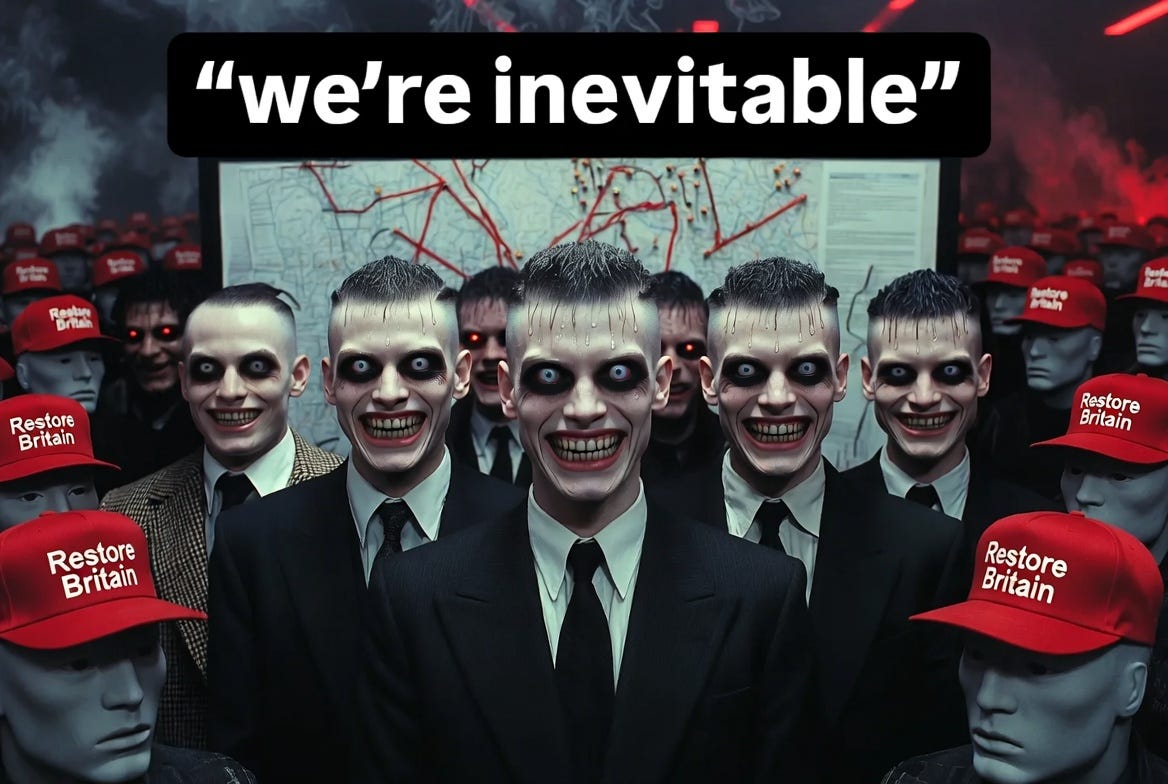
It’s regrettable, because I viewed Charlie in particular as one of the few people in this business (whatever you want to call it) whose talent and sincerity matched his ambition. But right now, all three of them just look like grifters to me. That said, I may not have drawn that conclusion at all, and would be far more receptive to their effort if they came across as the slightest bit humble or down to Earth, but they haven’t. They’re denoting historical necessity, referring to themselves as “inevitable” repeatedly as if they’re the incarnation of the cunning of reason, posing in suits and tweeds like some shit boy band that’s been in the top 40 for 69 weeks, and, from what I’ve seen, reverting to the same slopulist dualism as their competitors use whenever they come under fire for their lackadaisical approach to antisemitism and the British ethnicity question: saying that they’re only coming under fire because “establishment is scared of them” (to paraphrase a Tweet by Lewis). I’m sorry, but you don’t espouse such a simplistic interpretation with such nonchalance if your motivation is to make Britain a wholesome place to live, work and raise children again, because doing that requires either completely resetting the political culture (which they seem to be embracing), or bringing about a revolution of the kind that Restore’s membership would never consent to.
I understand that I’m being slightly facetious about the three of them here. I’m just really disappointed and disheartened that, given the resources that Rupert and others are providing, not to mention what’s at stake for the country in the next general election, the three of them have decided to go down the route of forming what looks like a Siloviki for under-30s instead of an intellectually rounded coalition of serious but diverse political thinkers (like what Ben Habib has done with the College at Advance).
This brings me onto…
Weakness 4: The Strategy
This is probably what’s going to trip Restore Britain up if Rupert doesn’t get a grip on this (and it has to be Rupert that gets a grip on this, because Charlie, Harrison and Lewis can only hear the voices echoing from their own walls).
The Restore camp has stated consistently that it views itself as a grassroots, bottom-up movement, which is precisely what you’d want to hear as an ordinary person who loves Britain and wants to repatriate Britain but doesn’t trust the bureaucracies of Reform or the Tories to follow through with what they’re proposing. Restore Britain’s approach seems to be that any patriot who wants to join can. They’re constantly churning out updates about their performance in the opinion polls and how many members they have because they want that image of growth and momentum to continue (hence the “we’re inevitable” gaslighting, I suspect). This is a quintessentially maximalist political strategy.
However, that appears to contradict their position on the British ethnicity question, which is explicitly exclusive. On social media, Charlie, Lewis and Harrison appear to have unified around the deterministic view that every product of Britishness is a metaphysical emanation of the essential nature of British people. They haven’t put it as esoterically as that, of course, but that’s the implication when they double down on the idea that Britain is a direct product of the contributions of British people. I understand that this position is maybe tactical because they want to distance themselves from Reform’s ‘magic soil’ position on the ethnicity question (if you like), but their alternative concept of ethnicity is just as shallow.
This shallowness is evident in some of the online campaign materials, such as one that contains the sentence: “you’re an Anglo-Saxon, act like it”. That would be fine if the party was named “Restore England”, but it isn’t: it’s “Restore Britain”. Native Britons, of that time, were literally being slain and having their villages ransacked by the men wearing those very helmets which are being associated with “Restore Britain” in this advert/poster. That’s not a very good look when you’re promoting what’s supposed to be a unionist party, to be honest. Of course, if some more senior personnel were overseeing what was being put out, that minor detail would have been ironed out, but it happened and has made them look like a bunch of larpers.
To a great extent, however, you can’t blame them for getting this wrong because ethnicity itself is very hard to define.
There is a never-ending debate concerning what Britain’s soul or essential fabric is, of course, and it’s never-ending because there are several angles through which you can understand it. But the one I find the most compelling and philosophically substantive is the view that the soul of a nation and its subsequent character is not something you can coerce into existence. It is the product and result of some things just being what they are at a certain time and place, and subsequently renewed as they are proven to be useful. Desirable and, most importantly, a source of social bonding.
Sir Roger Scruton, in my opinion, does the best job of explaining it (other than Hegel, anyway). A nation and by extension an ethnicity is not created by its subjects; its subjects are merely emanations or participants in that soul and that nation’s regeneration. A soul and by extension, a nation’s character, develops and evolves almost autonomously, under a set of continuous geographical conditions that evolve gradually within a certain space at a certain time.
Restore Britain’s conception falls short because it omits the fact that DNA changes over time: it is itself shaped and perpetually transformed by one’s social and geographical environment. It is possible, and has been possible since time began, for people from another place to become ethnically something else, but it takes time, a lot of time (and I mean potentially hundreds of years, perhaps even thousands). It’s not something that can be forced, it’s not something that can be legislated, it’s not something that can be deduced to civic principles, as the Restore camp correctly says, but it’s not something that can be deduced to skin colour or ‘blood and soil’ either. All of the problems that Western European countries have faced are the result of integration being expected to happen too fast, and involving too many people in too little time, and the result of that is that the foreign value spheres that should have been disintegrated have renewed across generations, expanded, and embarked on colonising the pre-existing ones. (It is, without question, a social and moral crime against the British, who indeed “were never asked” if this was what they wanted).
^ Obviously, I’m preaching to the choir here. But even with the deportations that are being proposed, the shallow brand of ethnonationalism that Restore has seemingly adopted without much thought is nothing more than a racialised version of ‘we the people’. Things won’t get instantly resolved because of the demographic changes that will result from the deportations, and suggesting that it will is just affirming a causal fallacy, or to be more direct, selling people a lie. I know Restore aren’t saying that outright, but I simply haven’t seen or heard enough about how they’re going to rebuild Britain economically and socially aside from deportations, budget cuts, repatriating Christianity, getting rid of DEI and identitarian statements of intent here and there.
Speaking of identitarian statements of intent, as any new party would in the first few months of its existence, Restore is trying exceedingly hard to transmit the impression that the enormous membership that it has is very much a united front. But I can tell you for a fact that it isn’t. Charlie, Harrison and Lewis have alienated quite a few Restore members over their public takes on the British ethnicity question, and will split the membership further until they decide upon a more robust conception of British ethnicity to run with than “a country is its people”. However, I have the suspicion that Restore’s ambiguity on this subject might be intentional, and with respect to other people they don’t want to alienate (who have a very, very different politics to most of the membership).
This brings me to the final subject that needs to be addressed, which is perhaps the greatest concern that I have: Restore’s approach to foreign policy with Israel.
I have placed this subject in strategy out of concern for the possibility that transmitting certain social signifiers and narratives about Israel (and perhaps Jews generally) may constitute a secret part of Restore’s political strategy. I say this because I’ve noticed almost a systematic likeness among the social media activities of Restore’s official spokespeople, that involves content drawing metaphysical associations between Israel and evil being retweeted, while content showing Jews being harassed in London (for example) is ignored, seemingly out of preference for making a more general point: that had this crime happened to a non-Jewish white person, the incident would not have been given the same level of attention or political importance.
Now, before I say anything else, I should make it clear that I am emphatically not a so-called “Zioshill”. I’m quite well informed about what some Zionists see themselves as working towards, the extraordinary lengths that some people and lobby groups go to advance what they view as their given prerogative, and I’m more aware than most of the socialised paranoia at the heart of this discourse that prevents many people from even touching this issue. I don’t see it as remotely controversial to acknowledge any of this, and considering the manner in which Israel has behaved both militarily and on the international stage for some time, I don’t believe it’s unreasonable to suggest having a more distant relationship with Israel going forward. However, there is a sizable difference between making political adjustments in response to Israel’s contemptible activity (which can extend to publicly condemning it), and using whatever content you can find to renew historical canards about Jews being ahistorically and essentially impure or wicked. I worry that this may be an unstated part of Restore’s political strategy to appease the neo-Nazi adjacent people on the right who (and there’s no easy way to say this) believe that we fought for the wrong side in the Second World War. I really, really hope this is not the case because people like that are fanatics, not “based” in the slightest, and their involvement will counteract everything the party practically wants to achieve. However, given that Harrison, Restore’s Senior Fellow, was transparently getting friendly with Martin Sellner back in March, who has a documented history of putting swastika stickers on Synagogues, I have to say it isn’t looking very good and does unfortunately substantiate my fear that they’re adhering to a certain conception of the friends-enemies distinction.
Conclusion
Before I go, I’ll try to summarise my reasons for why I can’t support Restore Britain.
– The party needs a cohesive political philosophy to define what the Restoration movement is and it is clear they don’t have one. In particular, they haven’t explained what sort of “revolution” they’re proposing in the British political system, only that they’re going to be the ones conducting it.
– Most of their policies are shallow and poorly thought out, hence why they clash with the messaging. In its current form, the project just looks like heavily-clad Thatcherism.
– The motivations and moral character of a politician matter. And from personal experience, I don’t see any major difference in character between the people presenting themselves as the only alternative and the establishment they want to replace, except for the fact that they seem to want explicit antisemites in their movement. I’m not talking about anti-Zionists, I’m talking about those who identify the “Jewish problem” as one involving dirty blood. Perhaps what would help Restore is if they had their own definition of antisemitism.
– The personnel at Restore seem to have just as weak a conception of British ethnicity as those purporting that “being British” is just a passport. Having a solid conception is, in short, the key to justifying their policy on remigration and distinguishing themselves from Reform, but so far, everyone who has attempted it has embarrassed themselves and alienated parts of the membership as a result.
Last of all: serious questions need to be asked about what the official political strategy of Restore Britain is, for the simple reason that if it is what it arguably looks like, there is absolutely no way that Rupert Lowe would have signed off on it.